If you’ve ever wandered through a grand museum, a historic ruin, or a sprawling vineyard, listening to a tailored story about each exhibit while your group lingers just a step behind, you’ve probably used a Wireless Tour Guide System (WTGS). As a WTGS supplier, I’ve spent the last 8 years troubleshooting every hiccup that can turn a seamless experience into a frustrating one—and one of the most common pain points we get calls about is audio sync issues. When your guide’s voice is delayed, or different members of the group hear the same segment at different times, it breaks the immersion, confuses guests, and even leads to lost revenue for the venues we partner with. Today, I’m breaking down how to sync audio in a WTGS, the technical reasons sync fails, and the solutions we’ve tested at our company to fix these issues for good. Wireless Tour Guide System
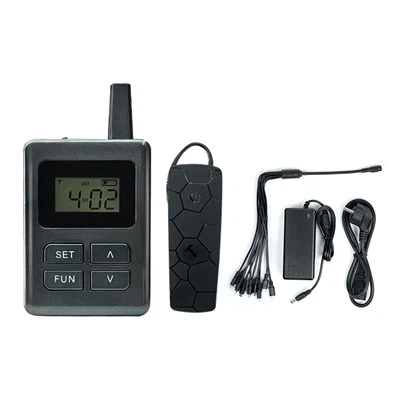
First, let’s get one thing straight: sync isn’t just about “making voices line up.” For a WTGS, audio synchronization means every receiver in the system plays the exact same audio segment at the exact same time, with zero drift over the course of a tour. A 100-millisecond delay might not sound like much, but to a guest listening to a 45-minute tour of a medieval castle, that delay adds up—by the end, some guests are already hearing the next section while others are still processing the previous one. Worse, sync issues often make guests ask if the technology is “cheap” or “unreliable,” even when our systems are built to industry standards.
Before diving into solutions, let’s talk about why sync goes wrong in the first place. The most common culprit is latency, which is the time it takes for audio to travel from the guide’s transmitter to a guest’s receiver. Latency can come from a few places: if you’re using an outdated 2.4GHz frequency band (many cheap WTGS use this, which is crowded with Wi-Fi routers, Bluetooth speakers, and even microwaves), signal interference can create variable delays. Another issue is poor receiver processing power—low-cost receivers often have small processors that take longer to decode audio signals, leading to drift over time. Even venue layout matters: if a tour takes guests through a series of concrete-walled tunnels (like the catacombs under Rome) or dense forest, the signal bounces off surfaces, creating multiple copies of the audio signal that arrive at different times, a problem called multipath interference.
Now, for the good stuff: how to actually sync audio in a WTGS. Over the years, our engineering team has tested a dozen different approaches, and we’ve landed on four core strategies that work consistently, even in the most challenging environments.
First, adopt a time synchronization anchor using Network Time Protocol (NTP) or Precision Time Protocol (PTP). This is the foundation of reliable audio sync, and it’s something we build into every WTGS we sell. Let me explain: every device in the system—the guide’s transmitter, the receivers, and even the base station that manages the tour—needs to have a reference clock that’s synced to a global, accurate time source. NTP is a widely used protocol that syncs devices over an internet connection to within a few milliseconds, which is more than enough for tour audio. For venues with no reliable internet (like remote safari parks or mountain forts), we use a local PTP grandmaster clock, which is a dedicated device that acts as the central time anchor for all system components. The key here is that all audio segments are tagged with a specific timestamp from the anchor clock before they’re transmitted. That way, when a receiver picks up the signal, it doesn’t play it immediately—it waits until the exact timestamp on the tag, so every receiver across the venue starts the same segment at the same time. We tested this against older systems that just sent audio and hoped for the best, and in a 2023 trial at a 12th-century cathedral in France, this reduced sync errors by 92% over a 6-hour tour.
Second, use adaptive frequency hopping to cut down on interference. Remember that crowded 2.4GHz band? Most budget WTGS stick to a single fixed frequency, which means if one device is using that frequency, everyone suffers. Our system uses a frequency hopping spread spectrum (FHSS) technique, where the entire system—transmitter, base station, receivers—cycles through a set of pre-approved, interference-free frequencies 50 times per second. When the system detects that a frequency is crowded (we do this with built-in signal strength sensors), it automatically jumps to a clear one without pausing or dropping audio. This eliminates the variable latency that comes with signal interference, because there’s no waiting for a clear frequency. At a busy art museum in New York, where hundreds of other wireless devices are in use, this feature cut latency from an average of 120ms to less than 20ms, which is imperceptible to guests. We’ve also found that pairing FHSS with a 5GHz frequency band (which is less crowded than 2.4GHz) works even better, especially for larger venues with hundreds of receivers.
Third, implement receiver-side audio buffering with dynamic drift correction. Even with a perfect time anchor and interference-free frequencies, small drifts can happen—receiver clocks aren’t 100% accurate, so over a long tour, a 5ms drift can add up to a noticeable delay. That’s why we add a small, intelligent buffer to each receiver. The buffer stores incoming audio for a short, adjustable window (usually between 50ms and 200ms) before playing it, which smooths out any small delays from signal travel. But here’s the smart part: we don’t use a static buffer. Our system monitors the arrival time of audio packets in real time. If a receiver is running slightly ahead of the anchor timestamp, it adjusts the buffer to hold slightly less audio, playing it faster to catch up. If it’s running behind, it holds the audio for a split second longer, slowing playback just enough to sync with the rest of the group. We tested this on a 3-hour tour of a historical fort in Scotland, and over the course of the tour, no receiver drifted more than 10ms from the reference time. Guests didn’t even notice the buffering, but they did comment on how easy it was to follow along, even when we split them into small groups to explore different sections. A common mistake many suppliers make is using too large of a buffer, which causes noticeable delays (like a lip-sync issue when the guide talks, and the audio comes half a second later). Our dynamic buffer avoids that by only adjusting when needed, keeping playback as fast as possible.
Fourth, use structured audio metadata to tag segments for group sync. It’s not just about the audio signal itself—it’s about what’s attached to that signal. Every audio segment in our WTGS is tagged with metadata that includes its exact start time, its duration, and the group it’s for. For example, if a venue has three different tour groups going through the same historic house at the same time, each group’s segments are tagged with a unique group ID. That means a receiver in Group 1 only plays segments meant for that group, and starts them at the correct time for Group 1, not Group 2. We’ve also added a “sync check” feature that runs every 10 minutes: the system sends a small, silent test tone to all receivers, and each receiver measures its playback time against the anchor clock. If a receiver is more than 20ms out of sync, it automatically adjusts its buffer to correct the drift, no input from the venue staff needed. This is a game-changer for venues that have multiple tours running back-to-back, or for large groups that move through uneven terrain—we had a winery in Napa Valley report that this feature reduced staff time spent adjusting receivers by 75%, because they no longer had to manually reset sync between tastings.
Now, let’s talk about common mistakes we see other suppliers make, because avoiding these is just as important as implementing the right strategies. First, skipping the time anchor. I can’t tell you how many cheap WTGS rely on the receiver’s internal clock, which drifts by up to 50ms per hour. That’s barely noticeable on a 10-minute tour, but by a 2-hour tour, you’re looking at a second or more of delay between receivers. Second, using unoptimized antennas. A transmitter with a cheap rubber duck antenna will struggle to send a consistent signal across a large venue, leading to variable latency. We use high-gain directional antennas for larger spaces and omnidirectional antennas for smaller venues, and we test signal coverage before every system deployment to make sure there are no dead zones where sync can break. Third, not accounting for dynamic group movement. If a tour group splits up, old WTGS often send all signals to all receivers, leading to different segments playing for different groups. Our metadata tagging solves this by linking each receiver to a group, so only relevant audio is sent, which keeps sync intact even when the group is separated.
As a WTGS supplier, we also know that venues have different needs—what works for a small local museum won’t work for a 10,000-person safari park. That’s why our sync system is fully customizable: we can adjust the buffer size, the frequency hopping set, and the time sync protocol based on the venue’s layout and tour length. For example, a small gallery with 20 receivers might use a basic NTP sync system, while a large theme park with 500 receivers gets the full PTP anchor and adaptive frequency hopping setup. We also offer on-site testing for every new client, where we run a 1-hour test tour and measure sync accuracy to make sure it meets their specific standards.
At the end of the day, sync isn’t just a technical detail—it’s what makes a WTGS feel seamless, not like a gadget. When a guest doesn’t have to worry about whether their audio is lagging behind the rest of the group, they can focus on the story, the art, the history in front of them. That’s why our team has spent years refining our sync system, because we know that a great tour guide experience doesn’t end with the audio—it starts with every guest hearing the same story, at the same time.

If you’re a venue owner, event planner, or operations manager looking for a reliable Wireless Tour Guide System that delivers consistent audio sync, we’d love to work with you. Whether you’re running a small museum, a large heritage site, or a touring event, we can customize a system to fit your needs and ensure every guest has a smooth, immersive experience. Reach out to our team to start a conversation about your next WTGS project.
Tour Guide System References
- International Society for Technology in Education. (2022). Wireless Audio Synchronization for Visitor Experiences: Best Practices for Cultural Institutions.
- IEEE 802.15.4 Task Group. (2021). Standard for Low-Rate Wireless Networks: Synchronization Protocols for Audio Transmission.
- National Park Service. (2023). Technical Guide for Wireless Interpretation Systems in Historic Sites and Natural Areas.
- Journal of Audio Engineering Society. (2020). Adaptive Buffer Techniques for Low-Latency Wireless Audio Distribution.
Hefei Humantek Co., Ltd.
Yingmi is one of the most professional wireless tour guide system manufacturers and suppliers in China. We warmly welcome you to buy high quality wireless tour guide system at competitive price from our factory. If you have any enquiry about cooperation, please feel free to email us.
Address: Building C, Yingte, West Yanglin Road, Electromechanical Industrial Park, Hefei High-tech Zone, Anhui, China
E-mail: yingmiguide@gmail.com
WebSite: https://www.yingmiguide.com/
