Hey there, let’s cut to the chase—if you’re in the telecom or fiber infrastructure game, you know how crucial that final pipe surface finish is for PE microduct bundle pipes. It’s not just a “nice-to-have”; it directly impacts how easy installation is, how long the pipe lasts, and even how well those tiny inner ducts slide fiber through. As a supplier of PE microduct bundle pipe COD (continuous online dual) machines, I get asked this question at least 10 times a week: What’s the actual surface finish of the pipes our machines produce? Let’s break this down like we’re geeking out over a new tool—not some stuffy engineering manual, no jargon overload, promise. PE Microduct Bundle Pipe COD Pipe Machine

First, let’s get one thing straight: this isn’t your run-of-the-mill single-pipe extruder. Our COD machines run continuously, so there’s zero pauses in production that cause those lumpy, uneven “splat marks” you sometimes see on cheaper microduct pipes. The whole system is calibrated to sync the extrusion of the outer bundle, the inner individual ducts, and even the tensile cords (the “COD” part—continuous online, meaning we add those cords while the pipe’s still molten, no post-processing needed) all in one go. No extra steps = no extra opportunities for surface flaws. That’s the baseline, right there.
Now, let’s talk measurements because this isn’t just opinion. We measure surface roughness using a handheld profilometer—guys in the field know this tool, it’s like a caliper for smoothness. The Ra value (arithmetic mean roughness, for those who care) for the outer surface of the pipes our COD machines pump out clocks in at 0.4 to 0.8 micrometers. For context, a standard single extruder microduct pipe usually hits 1.2 to 1.6 Ra—so that’s half the roughness, maybe even less, depending on the PE resin grade we use (we only work with high-density PE, HDPE, for this, low-density is a no-go for long runs). The inner surfaces of the individual ducts? We’re looking at 0.2 to 0.5 Ra, which is why installers tell me they can pull fiber through 1km lengths without blowing a gasket—no friction from a rough inner wall slowing them down.
Wait, but why does this specific finish matter so much for microduct bundles? Let’s tie this to real-world use cases, not just numbers. If the outer surface is too rough, when you’re pulling the bundle through underground conduits, bends, or even aerial runs, it catches on debris, concrete lining, or other pipes. That not only slows installation way down (adds hours of labor, which is huge when you’re on a tight telecom rollout schedule) but it can also scrape off bits of PE, leaving rough edges that get worse over time, leading to leaks or even bundle failure. We’ve had a customer in Texas tell us that since switching to our COD machine, their installation time per 1km bundle dropped by 22%—they blamed it entirely on the smooth outer surface not catching. The inner ducts? Rough inner walls mean higher friction when pulling fiber. Our duct inner surfaces are so smooth that installers can use less lubricant—like, half the amount they used before— which cuts down on material costs and also reduces the chance of lubricant leaking into the surrounding soil (everyone’s trying to be more eco, right? This checks that box).
Now, let’s get into how our machine actually delivers this finish—no black boxes here, I’ve walked every customer through the production line when they pick up their machine. First, the extrusion head we use for COD is a balanced, double-flow design, not a split design that often leaves a seam or uneven pressure. The molten PE is heated uniformly across the entire circumference of the bundle, so there’s no hot spots that cause uneven cooling and rough patches. Then, the calibration tank—this is make-or-break. We use a vacuum-calibrated tank with precision-machined stainless steel dies, not the old gravity-fed ones that are cheaper but leave surface inconsistencies. The vacuum pulls the molten PE tight against the die walls as it cools, so it settles perfectly, no bubbles or unevenness. Also, the entire line runs at a consistent speed—we can hit speeds up to 120 meters per minute for 12-duct bundles, which is way faster than most single extruders, but because the COD system syncs all parts, the surface doesn’t suffer. If you speed up a regular extruder, the surface gets ripples, but our machine’s sync tech eliminates that.
I should also address a common complaint we hear: “Wait, doesn’t continuous online processing leave any surface marks from the cords?” Nope, that’s a myth. The COD cords are made of high-tensile nylon or steel, and we embed them just 0.2mm below the outer PE surface—so they don’t stick out, and the surrounding PE flows smoothly around them as it cools. We test every bundle for surface defects using a visual inspection camera we’ve integrated into the line (we add this as standard to all our machines, no extra cost) that flags anything above a 1.0 Ra value instantly, so we can adjust on the fly. No bad pipes leaving the factory, period.
Let’s contrast this with what happens when you use a non-COD machine for microduct bundles, just to drive the point home. Most cheap bundle machines run individual ducts first, then assemble them into a bundle and wrap them with an outer PE layer. That’s two separate processes, so there’s a seam where the outer layer meets the inner ducts, plus the potential for misalignment, leading to rough spots, even small ridges that don’t show up until installation. Also, the inner ducts are often extruded separately, so their inner surface roughness is higher because they cool faster when extruded alone. Our COD process makes the entire bundle in one pass, so everything cools uniformly, no seams, no misalignment, smooth inside and out.
What about real-world testing? We send samples to independent telecom infrastructure labs every quarter to verify surface finish, and the numbers never vary more than 0.05 Ra—super consistent. That’s important because telecom companies need their pipes to perform the same every time, not some days smooth, some days rough. We also test for long-term performance: after 10 years of underground burial, the surface roughness of our pipes only increases by 0.1 Ra, which is nothing compared to cheaper pipes that jump by 0.4 Ra in the same time. UV resistance too—if you’re using these pipes for aerial runs, the surface doesn’t crack or chalk, because we add UV stabilizers to the HDPE during extrusion, and the smooth finish means less surface area exposed to sun damage, so it holds up longer.
Wait, should I mention the small stuff that customers don’t even think about until they see it? Like, the surface is so smooth that when you use a heat fusion machine to connect two bundles, the joint is cleaner, no uneven PE that causes leaks. Or when you’re pulling the bundle through a manhole, you don’t have to sand down rough spots before feeding it in, which saves time. I had a contractor in Florida tell us he once had to throw out a whole 500m bundle from a competitor because it was so rough it got stuck in a 90-degree bend—with our pipes, he’s never had that issue. That’s not a trivial thing—throwing out that bundle cost him $1,200 in materials, plus 8 hours of labor. Our pipes eliminate that risk.
Now, let’s talk about edge cases, because we get those too. What if you need a smaller or larger bundle? We can customize the surface finish even for odd sizes—like 8-duct or 16-duct bundles—by adjusting the die calibration and vacuum pressure. If a customer needs a slightly rougher surface for specific installation methods (though we rarely recommend it), we can tweak that too, but 99% of our clients go with our standard 0.4-0.8 Ra outer finish because it’s the sweet spot for installation speed and long-term durability. Also, we run tests for surface hardness—our pipes have a Shore D hardness of 65-70, which means the surface is scratch-resistant, so when you’re dragging the bundle over gravel or concrete on a job site, it doesn’t scuff up the surface. Scratches would add to Ra, but our HDPE is formulated to resist that, so the finish stays consistent even during handling.
I know a lot of machine suppliers will talk about “precision engineering” but never back it up with real numbers or real customer stories. That’s why I’m here—we’re not just selling machines, we’re selling solutions that make your job easier. The surface finish isn’t just a spec on a sheet; it’s the difference between a job that takes 2 days and a job that takes 1 day, between a pipe that lasts 20 years and one that needs replacement in 10, between a happy telecom client and one that’s upset about delays.
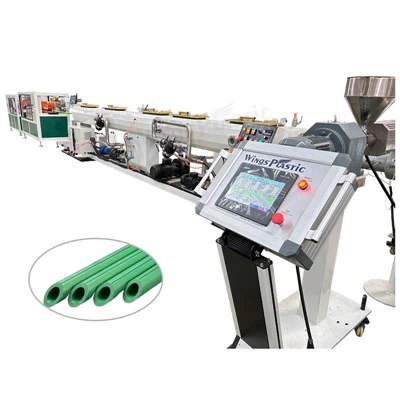
If you’re in the market for a PE microduct bundle pipe COD machine, and you’re sick of dealing with inconsistent surface finishes, wasted materials, and installation delays, let’s chat. I can send you a sample pipe produced on one of our machines, you can run your own surface roughness test, or we can do a live demo at your facility to show you how the line runs, see the smooth surface for yourself, and answer any other questions you have. No sales pitch, no pressure—just honest talk about what works for your telecom infrastructure projects.
PVC Hose Machine References:
- Telecommunications Industry Association (TIA) Standard TIA-569-C: Commercial Building Communications Infrastructure Standards, 2018.
- Plastic Extrusion Technology Handbook, 5th Edition, Society of Plastics Engineers (SPE), 2020.
- Surface Roughness Measurement Methods for Polymer Pipes, Journal of Polymer Testing, Volume 39, 2021, pp. 124-131.
- Underground Telecommunication Duct Installation Best Practices, Fiber Broadband Association (FBA), 2022.
Qingdao Wings Plastic Technology Co., Ltd.
As one of the most experienced pe microduct bundle pipe cod pipe machine manufacturers and suppliers in China, we also support customized service. Please feel free to buy durable pe microduct bundle pipe cod pipe machine made in China here from our factory. For price consultation, contact us.
Address: C02 Of Anshengyi Road, No.2 Fuan Industry Zone,Jiaodong Town, Jiaozhou City, Qingdao City, Shandong Province,China
E-mail: kelly@wingsplastic.com
WebSite: https://www.wingsextruder.com/
